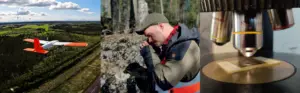
Between your exploration area and your desired data needs, Radai is taking care of everything
With permits to fly in 7 countries, since 2013, Radai provided environmental and geophysical measurement services using Unmanned Aerial Vehicles (UAV) to over 40 customers, performed 155 drone surveys, and flown over 250 000 line-km.
Radai's Geophysical Services

Radai provides fully integrated drone-based geophysical services for mineral exploration, geological mapping, environmental monitoring and conductivity mapping.
Our superior value proposition is maintained by a highly skilled team with an innovative mindset, which continuously looks for solutions to solve customer’s problems.
Radai’s services are tailored to customers’s needs. Our experienced team manages the complete workflow—from survey planning and data acquisition to processing, modelling and interpretation—using Radai’s in-house developed software and technologies (Read more).
Customers receive high-quality datasets, maps and reports that support informed decision-making through fast, flexible, accurate and cost-efficient geophysical solutions.
Magnetic Field Measurements (Video & Overview)
Radai delivers highly accurate drone-based magnetic total field and vector magnetic surveys. By installing cutting-edge magnetometers onto autonomous UAV flight platforms, we efficiently map complex subsurface structures to provide clear visualization of geological assets.So far, Radai provides the following magnetic survey services: Drone-based magnetic total field surveys, Drone-based vector magnetic surveys.
Technical Capabilities & Target Parameters
- High-precision fluxgate and potassium sensor integration
- Autonomous terrain-following altitude optimization (down to 10m)
- Simultaneous total field & multi-component vector recording
Radiometric surveys (Video & Overview)
We provide advanced 3D inversion of vector magnetic and electromagnetic data. By processing high-density aerial datasets, our processing team provides deep structural interpretations and geological depth models to assist targeting phases.
Radiometric surveys (Video & Overview)
Radai’s novel EM survey system provides information about the electrical conductivity of the subsurface. The applications of the EM system include geological mapping, mineral exploration, groundwater studies, geotechnical investigations, and environmental monitoring. The airborne system has the benefit of avoiding terrain obstacles and, thus, offers faster, safer, more cost-effective survey data.. (Read more)
Key concept
- Semi-airborne version uses fixed ground loop transmitter & airborne 3-component receiver towed by a VTOL drone
- Fully airborne version uses small (r<0.6m) transmitter loop attached to the towing drone
- Noise level < 20 fT 3 frequencies (2.3, 4.6, 9.2 kHz) 1 Hz sampling
- Depth of exploration 1-300 m
- Data post processing by 1D and 3D inversion
Data interpretation (Overview)
Radai provides advanced geophysical data interpretation services that transform drone-based magnetic, electromagnetic (EM) and radiometric measurements into actionable geological information. The services include data processing, spatial analysis, geological interpretation, anomaly identification, 3D modelling and integration of multiple geophysical and geospatial datasets to identify structures and prospective targets. The resulting maps, models and interpretations help mineral exploration customers prioritize targets, optimize follow-up surveys and drilling, and reduce exploration costs and uncertainty.
Radai offers high-resolution ground geophysical surveys designed to complement drone-based measurements and provide detailed information on priority exploration targets. Services include ground magnetic, electromagnetic (EM), and radiometric surveys, enabling more precise characterization of geological structures, conductivity, target depth and geometry, and variations in potassium, uranium and thorium. By integrating ground measurements with UAV datasets, Radai delivers a more comprehensive understanding of subsurface geology, helping to reduce exploration risks and improve mineral targeting and resource-development decisions. (Read more)
Superior Resolution
High-resolution data from low-altitude measurements.
More Flexible Field Operations
Flexible deployment and fast survey planning
More Cost Efficient
Drastically cuts down field crew overhead and equipment logistics.
Safer for Workers
Minimizes personal exposure in unpredictable remote terrain.
Faster Exploration Process
Accelerates campaign timelines with real-time field data delivery.